github:vercel/next.jsApp Router, middleware, build pipeline
GITHUBPUBLIC BOX
Ready
The nbx CLI compiles your codebase into a local knowledge graph your agents can query. LLM-free.
curl -fsSL https://install.noodlbox.io | bash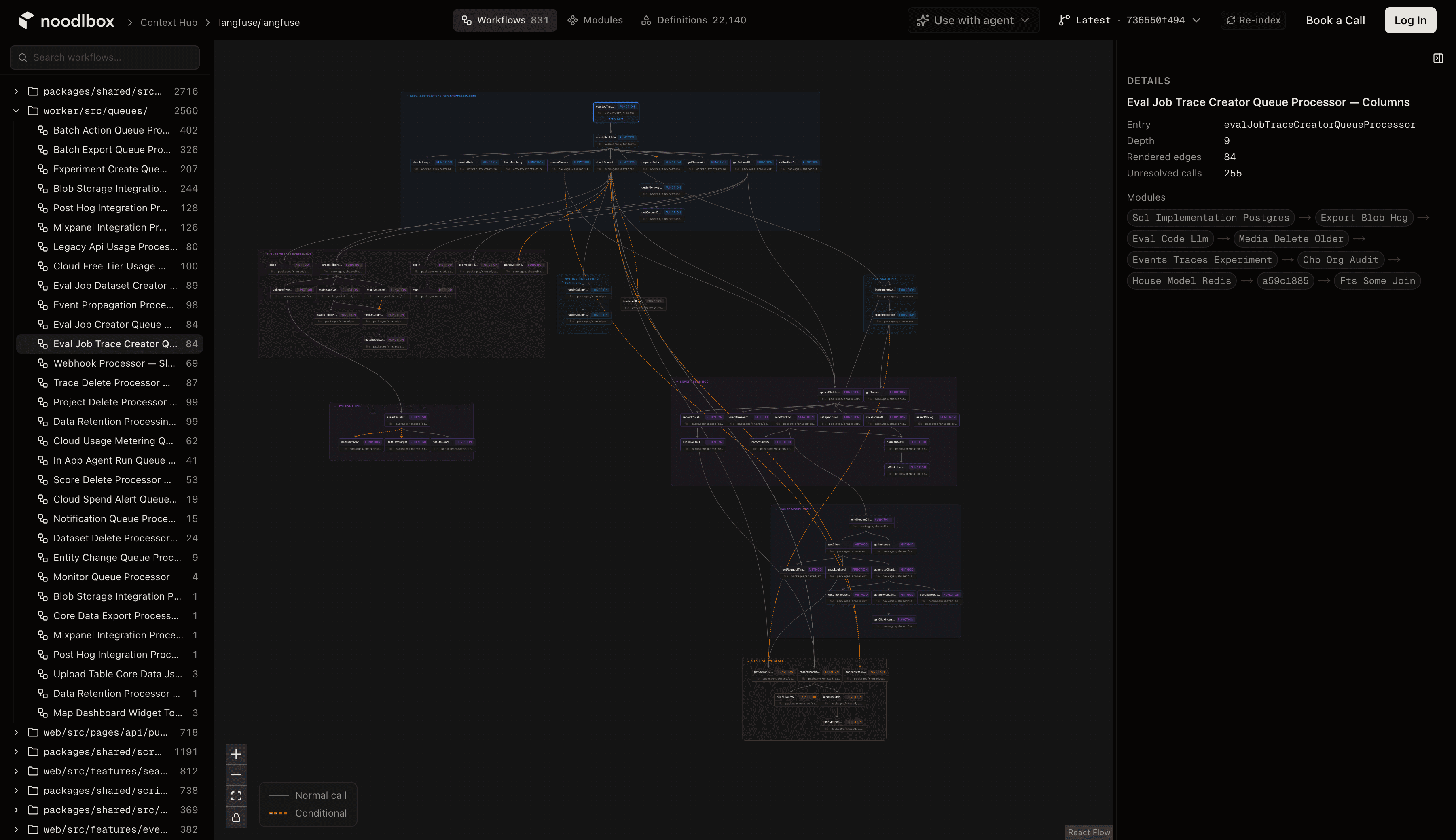
nbx init resolves the repository into symbols, relationships, communities, and workflows — one local graph every command can reuse.
nbx initnbx search follows calls and workflows to return the symbols, definitions, and communities that belong in the task's context.
nbx search "auth refresh flow"Models should reason about code, not how to find it.
Compute retrieval. Reason over results.
nbx def returns the definition, callers, callees, references, and functional community for one symbol.
nbx def refreshToken --file auth/session.ts{
"status": "found",
"symbol": {
"uid": "8f3c91d1c9f6f9c9e5e9c6a91f3b52e22ca89b771d2c1f0d30f70b13ea80264a",
"name": "refreshToken",
"kind": "Function",
"file_path": "auth/session.ts",
"start_line": 84,
"start_column": 0,
"end_line": 98,
"signature": "async function refreshToken(session: Session)"
},
"incoming": {
"calls": [
{
"symbol_uid": "2a29a1ee41b5c933",
"name": "retryOn401",
"file": 1,
"line": 121,
"kind": "Function"
},
{
"symbol_uid": "317fe15d507be34a",
"name": "warmSessions",
"file": 2,
"line": 63,
"kind": "Function"
}
]
},
"outgoing": {
"calls": [
{
"symbol_uid": "74c5b0129a32dc41",
"name": "rotateStore",
"file": 0,
"line": 103,
"kind": "Function"
},
{
"symbol_uid": "be91f97031140120",
"name": "persistSession",
"file": 0,
"line": 118,
"kind": "Function"
}
]
},
"files": [
"auth/session.ts",
"web/api-client.ts",
"jobs/session-warmer.ts"
],
"community": {
"community_uid": "auth-session-43",
"label": "Auth & Session",
"size": 43
},
"documents": []
}nbx query traverses symbols and typed relationships directly for precise structural questions.
Graph schema and supported Cypher →nbx query '
MATCH (caller)-[r:CALLS]->(target)
WHERE target.name = "refreshToken"
RETURN caller.name AS caller,
type(r) AS relationship
'[
{
"caller": "retryOn401",
"relationship": "CALLS"
},
{
"caller": "warmSessions",
"relationship": "CALLS"
}
]146 scored tasks across four corpora. Separate per-corpus means: how much of the answer key appears in the first 8K tool-response tokens.
See full results and methodology →| Corpus | noodlbox | ripgrep with targeted reads |
|---|---|---|
| 83% | 14% | |
| 79% | 19% | |
| 69% | 8% | |
| 53% | 18% | |
| 2.3.18 harness-scored | ||
Answer key: Code symbols touched by a known solution patch.
A deterministic ripgrep-plus-targeted-reads baseline, not an adaptive coding agent. This measures retrieval coverage, not solve rate, total session cost, or latency.
The reports, frozen answer keys, checksums, and scoring code are public. You can rescore the published reports and recompute their curves. Rerunning retrieval or regenerating the answer keys still requires an unpublished evaluation engine, so this is reproducible scoring, not full end-to-end reproduction.
Popular repositories, already compiled into public boxes.
QUERY IT LIKE ANY BOX
nbx search "router cache" --hub github:vercel/next.js--hub and the command reads your local box.PREVIEW AGENT INSTRUCTIONS ↗Fast, deterministic context for the code you are editing.
What runs locally, what reaches the agent, and where the free line sits.
It resolves source code into stable symbols, relationships, communities, and workflows, giving agents better search across definitions and execution paths without discovering the repository from scratch.
Grep matches strings and vector search matches similarity. Noodlbox also follows resolved symbol identity and typed code relationships, so a query can return the definitions and execution paths that belong together rather than a pile of nearby text.
No. Private source and its compiled graph stay local. Repository registration sends a hash of the remote identity so Noodlbox can issue a signed allowance; it does not store the private repository URL or its code.
Any coding agent that can run the local CLI. The setup prompt installs the nbx skill for Claude Code, Cursor, Codex, and OpenCode; other agents can invoke the same commands directly.
TypeScript, JavaScript, Python, and Java are stable. Go is in beta, and Rust is in preview.
Public boxes are unlimited, and your first private box is free forever. There is no timed trial or query cap. Basic unlocks unlimited private boxes.
Yes. A box can compile several related repositories into one context boundary. If any repository in that box is private, the box counts as private.